
Embarking on the journey to find the perfect engagement ring is a profound and exciting step. Often, the first consideration is the budget. The answer to “How much should I spend?” is deeply personal. It’s about achieving a beautiful balance between the ring of your partner’s dreams and a budget that feels comfortable for you it is not about adhering to an outdated three-month salary rule. Establishing this clarity from the outset ensures the entire process is confident and joyful.
Setting a Budget Beyond Outdated Rules
The path to a magnificent engagement ring begins not with diamonds, but with a considered, honest approach to finances. While it may not seem romantic, taking this step first transforms the experience into one that is exciting and affirming, rather than a source of stress. The objective is to establish a budget that genuinely reflects your shared values and current life stage.
The most liberating action you can take is to disregard the “three-month salary” myth. This concept originated from a clever marketing campaign of a bygone era and holds little relevance for modern Australian couples, who are often managing other significant financial goals, such as saving for a home or planning future adventures together.
A well-considered budget is not a restriction; it is a roadmap for creativity. It empowers you to make intelligent decisions about where to allocate your funds, whether in the diamond’s quality, a bespoke design, or a premium metal to achieve the most beautiful ring possible for your investment.
Instead of being constrained by arbitrary rules, consider what this ring truly symbolises for you as a couple. This simple shift in perspective elevates the conversation from one of cost to one of enduring value.
What Are Australian Couples Actually Spending?
It is natural to be curious about current trends. While every couple’s financial situation is unique, understanding the general landscape can be a helpful guide. Recent data indicates the average spend on an engagement ring in Australia typically falls between $5,000 and $15,000.
Of course, this figure can vary significantly depending on the diamond’s quality, the metal selected for the band, and the choice of a custom design. While natural diamonds are a timeless classic, we are observing a significant rise in the popularity of lab-grown diamonds. They offer a more accessible price point without compromising on brilliance, which is a compelling advantage for many.
Having a realistic budget provides clarity. When you know your financial comfort zone, our artisans can guide you toward the finest options within that range, ensuring you never feel pressured or overwhelmed.
Australian Engagement Ring Budget Expectations
To provide a clearer perspective, here is a practical breakdown of what different budget levels can typically achieve. This is not a set of rules, but a guide to the possibilities.
| Budget Range (AUD) | Typical Diamond and Stone Options | Popular Metal Choices | Common Design Styles |
|---|---|---|---|
| $2,500 – $5,000 | High-quality lab-grown diamonds (up to 1.0 carat), smaller natural diamonds, or alternative gemstones like morganite or sapphire. | 18k Gold (Yellow, White, Rose) | Classic solitaire, simple pavé bands, or minimalist designs. |
| $5,000 – $10,000 | Larger lab-grown diamonds (1.0-2.0 carats) with excellent specifications, or quality natural diamonds around 0.50-0.70 carats. | 18k Gold, Platinum | Solitaires with hidden halos, delicate three-stone settings, or more detailed pavé work. |
| $10,000 – $20,000+ | Premium, large lab-grown diamonds (2.0+ carats), or high-quality natural diamonds (1.0+ carats) with top-tier cut, colour, and clarity. | Platinum, 18k Gold | Intricate halo designs, complex custom creations, or designs with significant side stones. |
This table illustrates how your budget can be intelligently allocated across the different elements of the ring to create something truly stunning.
How Different Choices Shape Your Budget
Understanding how each element of the ring contributes to the final price is the key to investing wisely. The three primary factors that influence cost are the centre stone, the band metal, and the complexity of the design.
Here’s a brief overview of how your choices can impact the budget:
- Lab-Grown vs. Natural Diamonds: This is a significant consideration. Opting for a lab-grown diamond can allow you to acquire a larger or higher-quality stone for the same budget as a smaller natural diamond. As they are chemically and visually identical, it is a superb choice for those focused on maximising value and brilliance.
- Precious Metals: 18k gold (in yellow, white, or rose) and platinum are premier choices, but they are positioned at different price points. Platinum is denser and rarer, making it the more premium option. 18k gold, conversely, offers a luxurious feel at a slightly more moderate price.
- Design Complexity: A timeless, elegant solitaire setting will always be more budget-friendly than an elaborate halo or a detailed pavé design, which requires a greater number of small diamonds and significantly more intricate work from our craftspeople.
By understanding these trade-offs, you can confidently decide what is most important to you and your partner. We also offer a detailed guide that covers more of the key things to consider when buying an engagement ring to help you feel even more prepared.
Ultimately, the ‘right’ budget is one that allows you to purchase a beautiful, meaningful ring you are both proud of, without placing a strain on your shared future. That thoughtful approach is what makes the ring a symbol not just of your love, but of your partnership.
Understanding the 4 Cs for Unparalleled Brilliance
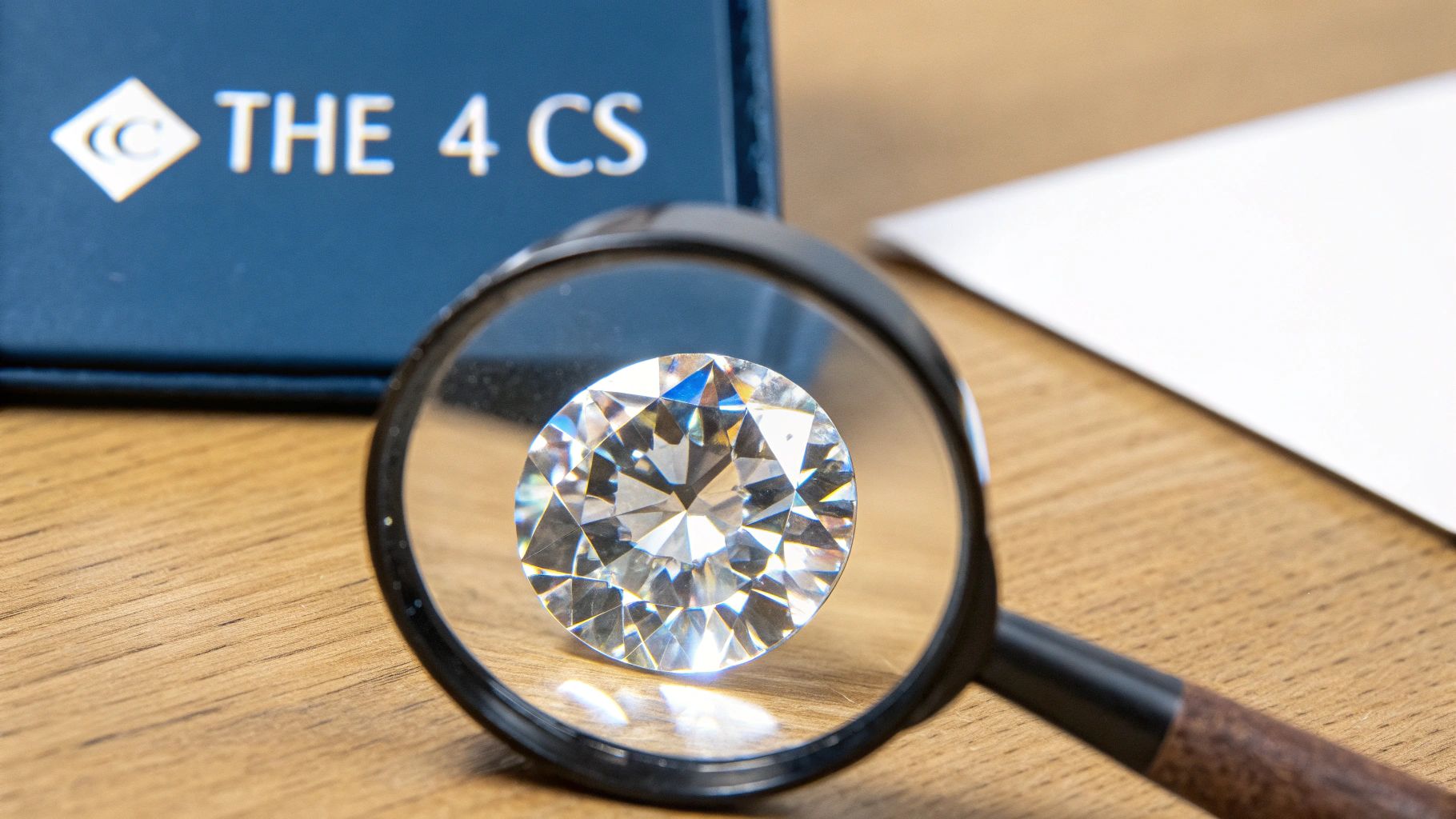
As you begin your research on how to choose an engagement ring, you will frequently encounter the term “4 Cs.” These four pillars Cut, Colour, Clarity, and Carat are the globally accepted standards for grading a diamond’s quality. True understanding, however, goes beyond mere definitions. It is about learning how these elements interact to create the incredible, heart-stopping sparkle your partner will adore.
While all four Cs are important, they are not all equal in their impact. The secret to achieving the absolute most for your budget is knowing where to invest and where you can be strategic. This expert knowledge allows you to look beyond the certificate and appreciate a diamond for its true, mesmerising beauty.
The Cut Is Always King
If there is one piece of advice we can impart, it is this: always prioritise the Cut above all else. The Cut is what truly brings a diamond to life, unlocking its fire, brilliance, and sparkle. It has nothing to do with the diamond’s shape (such as round or oval) and everything to do with the exceptional skill of the artisan who faceted the stone.
A diamond graded as ‘Excellent’ or ‘Very Good’ for its cut will dance with light, appearing vibrant and alive. A poorly cut diamond, by contrast, allows light to leak out from its sides and bottom. The result is a dull, glassy-looking stone, regardless of its colour or clarity.
A phenomenal cut can make a diamond appear larger than its carat weight and can even mask minor inclusions or a slightly lower colour grade. It is the one C where compromise will have the most significant and disappointing impact on the ring’s beauty.
Think of a diamond as a series of tiny, intricate mirrors. When angled perfectly (an excellent cut), they create a dazzling hall-of-mirrors effect that directs light back to your eye. When the angles are imprecise, that light is lost, and so is the magic. For a more detailed examination, you can explore our comprehensive guide to the 4 Cs of diamonds, which breaks down every element.
Finding Smart Value in Colour and Clarity
Once you have secured a diamond with a superb cut, you can find exceptional value by being strategic with Colour and Clarity. These are two areas where a grading report can be misleading without expert interpretation.
Diamond Colour is graded on a scale from D (completely colourless) to Z (light yellow or brown). While D is the rarest and most valuable, the visual difference between a D, E, and F grade is practically imperceptible to the naked eye.
- A Savvy Choice: Consider a ‘near colourless’ diamond, in the G to H range. These stones offer incredible value and appear stunningly white to the eye, especially when set in yellow or rose gold, which naturally imparts a warm glow.
- Diamond Clarity refers to the absence of tiny internal features (inclusions) and surface marks (blemishes). The scale runs from Flawless (FL) to Included (I). Similar to colour, many of the minute imperfections in VS (Very Slightly Included) or even SI (Slightly Included) grades are only visible under a jeweller’s loupe.
- A Savvy Choice: Your objective should be to find an ‘eye-clean’ diamond, one with no flaws visible to the naked eye. An SI1 diamond can often be perfectly eye-clean and cost significantly less than a VVS stone, freeing up your budget for a better cut or a larger carat weight.
By focusing on what is beautiful to the naked eye rather than what is perfect on paper, you make an intelligent choice that delivers maximum visual impact without paying for unseen perfection.
Carat Weight vs. Visual Size
Carat is a measure of a diamond’s weight, not its physical dimensions. While carat weight is a primary driver of price, two diamonds of the exact same weight can appear surprisingly different in size depending on their cut and shape.
A beautifully cut diamond with a wider top surface (the ‘table’) will look larger than a deep, poorly proportioned diamond of the same weight. This is yet another reason why the Cut is paramount, it directly influences how large your diamond appears.
When considering carat, keep these points in mind:
- Shape Matters: Elongated shapes like oval, pear, and marquise cuts tend to appear larger per carat than round or square shapes.
- The Setting’s Influence: A halo setting is a classic way to make a centre stone appear significantly larger. A slim, delicate band can also create a flattering proportion that accentuates the diamond.
- “Magic Numbers”: Diamond prices tend to jump at key weights like 1.00 ct or 1.50 ct. Opting for a diamond just under these milestones, such as a 0.95-carat stone, can yield significant savings for a size difference that is visually undetectable.
Discovering a Style That Reflects Their Personality
Beyond the brilliance of the diamond or the figures in your budget, the true heart of choosing an engagement ring lies in finding a design that feels as if it were created just for them. An engagement ring is worn every day; it becomes a part of their identity. The goal is to select a style that so perfectly captures their essence that it feels like a natural extension of who they are.
This is the part of the process where you become a style detective. By paying close attention to their existing preferences, you can gather all the clues needed to choose with confidence, ensuring the ring is a true reflection of their unique personality.
Becoming a Style Detective
The most effective way to determine their ideal ring style is to observe the choices they already make. You do not need to ask directly and risk spoiling the surprise; their personal aesthetic provides clues everywhere.
Begin by examining the jewellery they currently own and wear.
- Is it minimalist and modern? They would likely adore a sleek, timeless solitaire on a simple band.
- Is it bold and glamorous? A stunning halo setting or a ring with intricate pavé details could be the perfect match.
- Does it have an antique or unique feel? They might fall in love with a vintage-inspired design featuring delicate metalwork and unique details.
Consider the colour of the metal they gravitate towards. Do they consistently wear yellow gold, or do they favour the cool tones of silver, white gold, or platinum? This is one of the most straightforward clues you can gather.
Look beyond their jewellery box as well. Consider their fashion choices and even their home decor. Someone who loves clean lines and a neutral colour palette will likely have different tastes in rings than someone who embraces vibrant colours, bold patterns, and eclectic decor.
Exploring the Spectrum of Ring Styles
Once you have a general sense of their aesthetic, you can begin exploring specific engagement ring styles. Each design possesses its own distinct personality.
- The Classic Solitaire: Timeless, elegant, and sophisticated. This style features a single, stunning diamond on a plain band, placing all the focus on the centre stone. It is the ultimate choice for someone with a classic and understated style.
- The Glamorous Halo: This design features a ring of smaller diamonds encircling the centre stone, creating a breathtaking halo of sparkle. It dramatically enhances the perceived size of the diamond and is perfect for someone who loves glamour and flair.
- The Meaningful Three-Stone: Representing the past, present, and future of your relationship, this style is rich with symbolism. It can feature a larger centre diamond flanked by two smaller stones, offering a classic look with added brilliance.
- The Intricate Vintage-Inspired: These rings draw on design elements from past eras, like the Art Deco or Edwardian periods. They often feature detailed metalwork, milgrain edging, and unique diamond shapes, appealing to someone with a romantic, old-soul spirit.
For more inspiration, you can explore our full gallery to see how to choose an engagement ring that makes saying yes unforgettable.
Gathering Intelligence Discreetly
If you remain uncertain, it may be time to seek reinforcements. A close friend or a family member such as a sister or mother can be an invaluable ally. They may have had conversations about ring styles previously or can find a clever way to bring it up without raising suspicion.
You could ask them to go “window shopping” for fun or to send you a photo of a ring your partner has admired. Just be sure to enlist someone you trust completely to keep your secret safe.
Ultimately, the goal is to choose a ring that feels personal and deeply considered. When they see it, they shouldn’t just think, “It’s beautiful.” They should think, “It’s so me.” That is when you know you have found the perfect one.
Choosing the Setting and Metal
Having determined the diamond’s shape and quality, it is time to select its home. The setting and precious metal you choose serve as the architectural foundation of the ring. This decision defines its character, secures the centre stone, and ensures its longevity. It is a balance between the ring’s overall style and its practical, everyday wearability.


The right combination of setting and metal will not only make the diamond look its absolute best; it will also feel perfectly suited to your partner’s lifestyle. Think of it as marrying form and function, beauty and strength.
Finding The Perfect Setting For Security And Style
A ring’s setting does much more than simply hold the diamond in place; it is a critical component of the design, shaping the ring’s entire personality. Different settings offer distinct looks and levels of protection for the stone.
Here are a few of the most popular choices our artisans frequently work with:
- Claw Setting: This is the classic, quintessential engagement ring setting. It uses tiny metal claws to grip the diamond, lifting it to catch light from all angles for incredible sparkle. While it offers a timeless, elegant look, a setting with four prongs is slightly less secure than one with six, a small but important detail.
- Bezel Setting: For a sleek, modern aesthetic and ultimate protection, a bezel setting is a superb choice. A thin metal rim completely encircles the diamond, holding it securely. This is an ideal option for anyone with an active lifestyle or a hands-on career, as it provides the best defence against knocks and snags.
- Pavé Setting: The term pavé (pronounced “pa-vay”) is French for “paved,” which aptly describes its appearance. This setting involves embedding tiny diamonds very close together into the band, creating a continuous, glittering surface. It adds a serious touch of glamour and can be combined with other settings for a truly show-stopping effect.
Your partner’s daily routine should be a major factor in this decision. A teacher or doctor might prefer a lower-profile, more secure bezel setting, whereas someone in an office environment may feel perfectly comfortable with a higher-set prong design. The goal is to choose a ring they can wear confidently every day.
Selecting The Ideal Precious Metal
The colour and type of metal you choose for the band have a profound impact on the ring’s overall look and feel. Each precious metal brings its own unique character, durability, and maintenance needs.
Yellow gold offers the classic, warm glow that has been cherished for centuries. Rose gold provides a romantic, vintage-inspired blush tone. For a cool, crisp white finish, the main contenders are white gold and platinum. While they appear quite similar at first glance, they have key differences in composition, durability, and cost. If you are considering these two popular options, we have a helpful guide comparing white gold vs. platinum in detail.
To help you decide, let’s look at the key attributes of the most popular choices for engagement rings.
A Comparison of Precious Metals for Your Ring
Choosing a metal is a deeply personal decision, and each has its own merits. This table breaks down the practical differences to help you find the best fit for your partner’s style and lifestyle.
| Metal Type | Appearance and Colour | Durability and Hardness | Long-Term Maintenance | Hypoallergenic Properties |
|---|---|---|---|---|
| Platinum | A naturally bright, silvery-white metal that never fades. | Extremely durable and dense. It scratches but doesn’t lose metal volume. | Requires occasional polishing to restore its high shine. | The premier choice for sensitive skin as it’s 95% pure. |
| 18k Yellow Gold | Rich, warm, and classic yellow hue. | A strong and durable choice for everyday wear. | Needs regular polishing to maintain its lustre. | Generally hypoallergenic, but can contain traces of nickel. |
| 18k White Gold | Bright white finish, similar to platinum. | Strong, but its rhodium plating can wear over time. | Requires re-plating every 1-3 years to maintain its bright white finish. | Contains nickel alloys, so it may not suit very sensitive skin. |
| 18k Rose Gold | A soft, romantic pinkish hue from its copper alloy. | Very durable due to the strength of its copper content. | Doesn’t require plating and develops a rich patina over time. | The copper alloy makes it generally safe for most skin types. |
Ultimately, choosing the metal comes down to a blend of personal preference, budget, and even skin tone. Cooler skin tones are often complemented by platinum and white gold, while warmer skin tones can be beautifully enhanced by yellow and rose gold.
By carefully considering both the setting and the metal, you are not just building a ring, you are crafting a durable, beautiful piece of art that perfectly captures your partner’s style and is ready for a lifetime of love and wear.
Finalising Your Purchase
You’ve designed the ring, you’ve chosen the perfect diamond, and you are now on the home stretch. This is where we finalise the details, ensuring the purchase is as seamless and joyful as the proposal itself.
We are now moving from the art of design to the practicalities of a sound investment. This stage is about determining the correct size, understanding the fine print, and protecting this beautiful piece for a lifetime.
This final stage is about building a foundation of trust and transparency, the very qualities an engagement ring symbolises.
Ensuring the Perfect Fit in Secret
One of the greatest anxieties in planning a surprise proposal is getting the ring size correct. Fortunately, you do not have to give away your intentions. There are several clever methods to determine it.
The most reliable method? If possible, discretely “borrow” a ring your partner already wears on the correct finger. Bring it to us, and we can measure it professionally, eliminating any guesswork.
If that proves too difficult, you could try one of these tactics:
- Trace it: Place one of their rings on a piece of paper and carefully trace the inside and outside of the band with a fine-tipped pen.
- Make an impression: Gently press their ring into a soft bar of soap. This creates a surprisingly clear mould of the inner diameter.
- Consult a friend: A close friend or family member can be your greatest asset. They might already know the size, or they could slyly work it into a conversation for you.
For a deeper dive, we have put together a resource with more professional tips. Check out our complete guide on how to measure ring size for additional guidance.
The Importance of Ethical Sourcing and Certification
In today’s world, choosing an engagement ring is about more than its appearance; it is about making a choice you can feel genuinely good about. Knowing your diamond has a pure and transparent history is paramount.
You should always seek diamonds that are compliant with the Kimberley Process Certification Scheme. This is an international agreement designed to prevent conflict diamonds from entering the market. For even greater peace of mind, lab-grown diamonds are a superb alternative. Because they are created in a controlled environment, their origin is completely traceable, making them an inherently ethical and sustainable choice.
Think of a diamond’s grading report as its quality blueprint. Issued by a respected gemological laboratory like GIA (Gemological Institute of America) or IGI (International Gemological Institute), this document is an unbiased, expert assessment of the 4 Cs. It confirms the stone’s authenticity and value and is non-negotiable for any significant diamond purchase.
Choosing a Jeweller and Understanding the Fine Print
The relationship you build with your jeweller is a significant part of the experience. A reputable jeweller is not just a salesperson; they are your trusted guide, offering transparent advice and standing behind their craftsmanship. You want to find a team that is passionate about their work and is happy to answer every one of your questions.
Before making your final decision, ensure you are clear on these essential details:
- Lifetime Warranty: This should cover any manufacturing defects. It is your assurance of the ring’s quality and structural integrity.
- Insurance and Valuations: A valuation certificate is crucial for insuring your ring against loss, theft, or damage. We always recommend arranging insurance as soon as you have made the purchase.
- Care and Maintenance: Ask about what is included. Do they offer complimentary cleaning and inspection services? Regular check-ups will keep the ring sparkling and ensure the setting remains secure for years to come.
Your Engagement Ring Questions Answered
The journey to finding the perfect engagement ring is incredibly exciting, but it is completely natural for questions to arise along the way. To help you feel completely confident as you move forward, we have compiled answers to the most common queries we hear from our clients. Think of this as the final piece of the puzzle, providing the clarity needed to make a beautiful choice you will cherish forever.
Lab-Grown vs. Natural Diamonds: What Is the Difference?
This is easily one of the most frequent and important questions we receive. Simply put, a lab-grown diamond is chemically, physically, and optically identical to a natural diamond. They are, in essence, twins.
The only true difference lies in their origin story. Natural diamonds were formed over billions of years deep within the Earth’s mantle under immense heat and pressure. Lab-grown diamonds are created within a highly controlled laboratory environment using advanced technology that replicates that same natural process.
This modern approach often makes lab-grown diamonds a more accessible and sustainable choice. It can allow you to choose a larger or higher-quality stone for your budget, without sacrificing any of that breathtaking sparkle.
How Can I Find My Partner’s Ring Size Secretly?
Determining the correct ring size without spoiling the surprise is a classic challenge, but rest assured, we have several trusted methods you can use. By far the most accurate way is to subtly borrow a ring your partner often wears on their ring finger (either hand works) and bring it to a jeweller for a precise measurement.
If you cannot sneak a ring away, here are a few other clever tactics:
- The Tracing Method: When they’re not looking, place one of their rings on a piece of paper and carefully trace the inside circle with a sharp pencil.
- Enlist a Confidant: A close friend or family member might already know the size, or they could find a subtle way to ask for you.
- Educated Guess: As a last resort, we can often make an educated estimation based on photos, but it is always best to have something more concrete. Remember, resizing is almost always an option, so try not to worry too much about this step.
Which of the 4 Cs Is the Most Important?
While all four C’s Cut, Colour, Clarity, and Carat contribute to a diamond’s beauty and value, most gemologists and artisans agree that the Cut is the most critical factor. The Cut is what truly unlocks a diamond’s potential, dictating its ability to reflect light and create that mesmerising sparkle.
A diamond with an ‘Excellent’ or ‘Very Good’ cut can appear brighter, more fiery, and even larger than a poorly cut diamond of a higher carat weight or colour grade. Prioritising the cut is the surest way to guarantee a visually stunning stone that truly captivates.
This means you can often be more flexible with the colour and clarity grades to get the most from your budget, knowing that a superior cut will deliver that all-important brilliance.
Should I Choose Platinum or White Gold?
Both platinum and white gold are superb choices for achieving that crisp, modern white-metal look, but they possess key differences that are worth considering.
Platinum is a naturally white metal, meaning its beautiful silvery colour will never fade or change over time. It is also denser and heavier than gold, and because it is typically 95% pure, it is the best hypoallergenic choice for anyone with sensitive skin.
White Gold is a stunning alloy created by mixing pure yellow gold with white metals like palladium and silver. To achieve its bright, mirror-like finish, it is plated with rhodium. While it is a very durable and beautiful option that’s more budget-friendly than platinum, it will require re-plating every few years to maintain its brilliant white lustre.
Ultimately, your decision will likely come down to your budget, your preference for the weight of the metal, and your thoughts on long-term maintenance.
At Australian Diamond Company, we believe that finding the perfect engagement ring should be a joyous and memorable experience. Our team of expert artisans and gemologists are here to guide you through every step, ensuring the ring you choose is a flawless reflection of your love story.
Explore our breathtaking collection of bespoke engagement rings at https://www.adc.com.au.


