
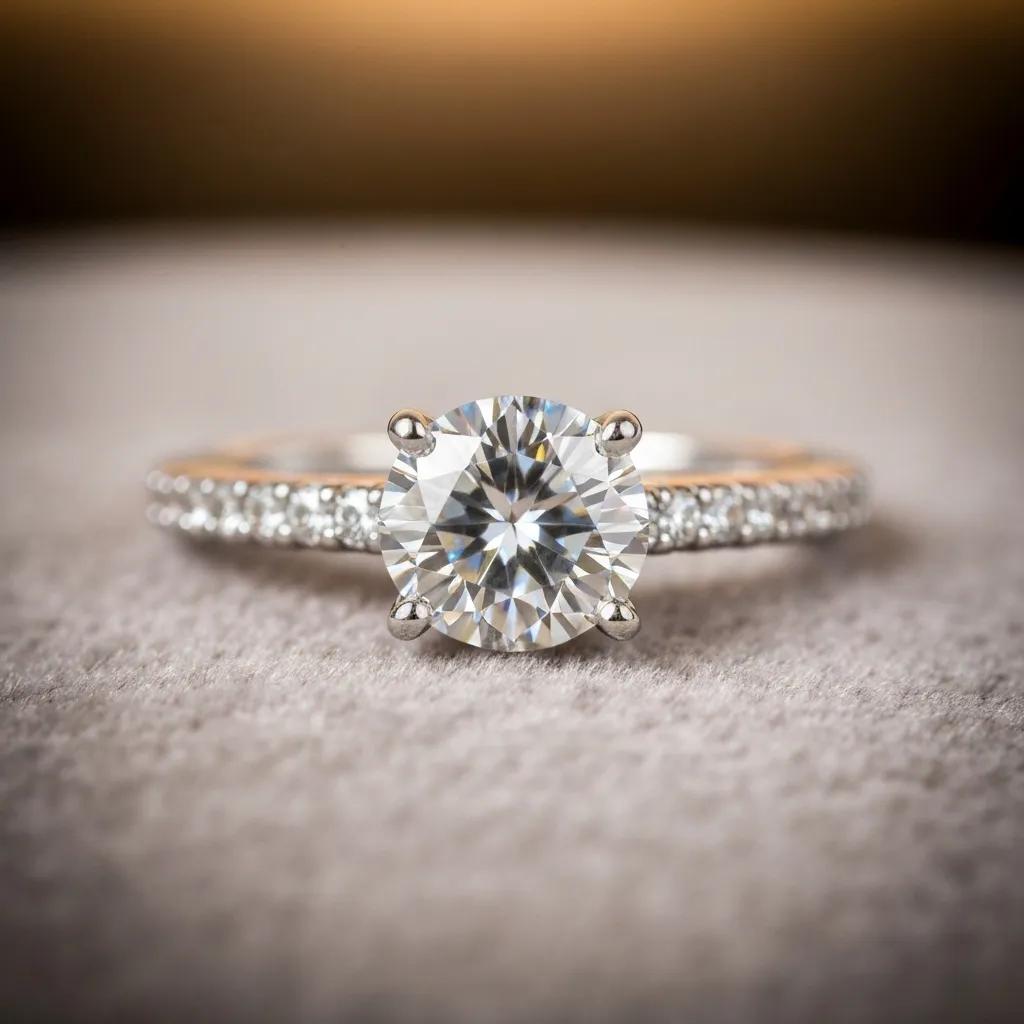
Diamond Grading: 4 Cs & Certification: Australian Diamond Company
Engagement rings are a beautiful testament to commitment and artistry, yet choosing the perfect diamond can feel daunting without a clear understanding of how quality is assessed. By delving into diamond grading scales, from the essential 4 Cs to trusted certification, you’ll gain the confidence to select a stone that perfectly balances brilliance, purity, and value. In this comprehensive guide, you’ll explore:
- The meaning of each of the 4 Cs and how they work together
- Why the quality of the cut is paramount
- How colour and clarity grades influence a diamond’s appearance
- The effect of carat weight on a diamond’s size and price
- Which certification bodies set the industry standard
- How lab-grown diamonds are graded
- Strategies for balancing quality, value, and your personal style
- Answers to your most pressing diamond grading questions
Featuring expert insights and practical advice from the jewellery specialists at ADC.com.au, this article is designed to equip you for a well-informed and joyful purchase.
Understanding the 4 Cs of Diamond Quality: Why They’re Essential
The 4 Cs, Cut, Colour, Clarity, and Carat Weight represent a universal language for evaluating a diamond’s quality and worth, established by leading gemological authorities. Each characteristic defines a crucial aspect of a diamond’s beauty and market value, ensuring that buyers can comprehend how light performance, hue, internal purity, and mass combine to create its brilliance and rarity.
An Overview of the 4 Cs in Diamond Grading
This research offers a thorough examination of the 4 Cs (Cut, Colour, Clarity, and Carat) used in diamond grading, explaining how each element impacts a diamond’s value and visual appeal. It underscores the importance of understanding these characteristics for making informed purchasing decisions.
Gemological Institute of America (GIA), “GIA Diamond Grading Report” (2024)
This reference supports the article’s explanation of the 4 Cs and their significance in determining diamond quality and value.
Diamonds graded across all four categories allow for direct comparison between stones and facilitate informed trade-offs that align with your budget and personal style. When the cut and colour deliver maximum sparkle, the clarity ensures purity under magnification, and the carat weight dictates its presence on the finger, you achieve a harmonious balance of aesthetics and intrinsic worth.
What is Diamond Cut and How Does It Shape Sparkle and Brilliance?
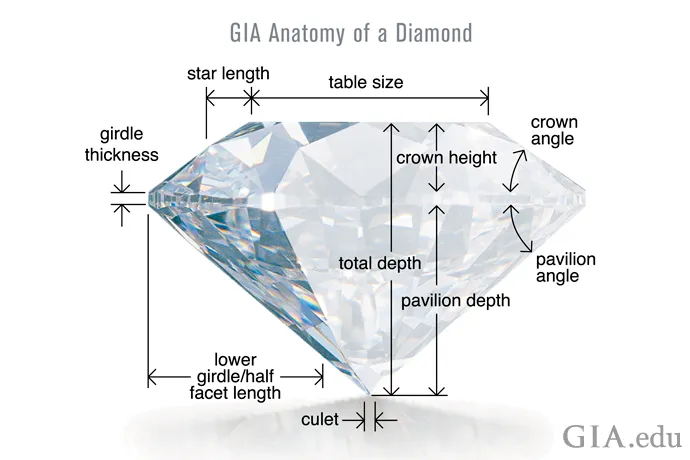
Diamond cut refers to the precision with which a stone’s facets are proportioned, polished, and aligned to optimise the reflection and refraction of light. An expertly cut diamond returns almost all incoming light through its crown, maximising its brilliance, fire, and scintillation. Conversely, poorly executed proportions can cause light to escape from the pavilion, resulting in a dull or lacklustre appearance.
Diamond Cut Quality and Its Impact on Light Performance
This study investigates the connection between diamond cut quality and light performance, illustrating how precise proportions, symmetry, and polish influence a diamond’s brilliance, fire, and scintillation. It highlights the paramount importance of cut as a primary factor in a diamond’s visual appeal.
The International Gemological Institute (IGI), “IGI Diamond Grading Report” (2024)
This citation reinforces the article’s focus on the critical importance of diamond cut quality and its effect on a diamond’s sparkle and brilliance.
A diamond with an excellent cut will appear larger for its carat weight and produce vibrant flashes of colour, maintaining its brightness even in softer lighting conditions, making cut the most crucial of the 4 Cs for everyday radiance.
How is Diamond Colour Graded Using the GIA D-Z Scale?
Colour grading assesses the absence of colour in white diamonds, with the GIA D–Z scale ranging from completely colourless (D) to a faint light yellow or brown (Z). Diamonds in the near-colourless grades (G–J) offer excellent value, appearing white to the unaided eye while being more affordable. Lower grades (K–Z) exhibit a subtle warmth that can be particularly appealing in vintage-inspired or yellow-gold settings.
By selecting a diamond within the appropriate colour range, buyers can prioritise maximum brilliance or embrace warmer tones for added character.
What Do Diamond Clarity Grades Signify and How Do Inclusions Affect Value?
Clarity evaluates internal inclusions and external blemishes under 10× magnification, with grades ranging from Flawless (FL), possessing no imperfections, to Included (I3), where inclusions may impact transparency. Most diamonds that appear eye-clean fall within the VS1–SI2 range, meaning no inclusions are visible without magnification. Higher clarity grades command higher prices, while carefully chosen eye-clean diamonds offer both beauty and excellent value.
How Does Carat Weight Influence a Diamond’s Size and Price?
Carat weight measures a diamond’s mass, with one carat equivalent to 0.2 grams. While weight is related to size, factors like cut proportions and shape can affect its apparent diameter. The price per carat increases significantly with weight, reflecting its rarity. For instance, a 1.00 ct diamond might cost less per carat than a 2.00 ct gem of identical quality. Therefore, a thoughtful balance between carat weight and the other Cs optimises both visual impact and budget.
How Do the 4 Cs Collectively Determine a Diamond’s Beauty and Value?
When considered together, the 4 Cs create a comprehensive assessment of optical performance, colourlessness, internal purity, and mass. A perfectly cut, colourless, eye-clean 1 ct diamond will exhibit exceptional sparkle, while a warmer-toned, slightly included 1.5 ct stone might offer a more substantial presence on the finger at a lower cost. Understanding the interplay of each C empowers you to prioritise the attributes that are most important to you, whether that’s maximum brilliance, ideal colour, or a statement-making size.
How is Diamond Cut Quality Assessed, and Why is it the Most Important C?
Diamond cut quality goes beyond the diamond’s shape and focuses on the precision of its proportions, symmetry, and polish. It directly dictates how light interacts within the stone, with superior cuts resulting in peak brilliance and captivating flashes of colour known as fire.
What Are the Cut Grades: Excellent, Very Good, Good, Fair, and Poor?
Cut grades rank a diamond’s craftsmanship based on established scientific standards:
- Excellent: Features ideal proportions designed for unparalleled brilliance and fire.
- Very Good: Possesses nearly ideal proportions, with only minor light leakage detectable under magnification.
- Good: Offers balanced light return, with a slight reduction in sparkle.
- Fair: Exhibits noticeable light loss, leading to muted scintillation.
- Poor: Shows significant light escape, resulting in a dull appearance.
Higher cut grades enhance a diamond’s face-up size and its everyday sparkle, making an Excellent or Very Good cut the preferred choice for fine jewellery.
How Do Proportions, Symmetry, and Polish Influence Diamond Fire and Scintillation?
The details of craftsmanship significantly shape a diamond’s optical performance:
- Proportions: Determine how light is refracted and returned to the eye.
- Symmetry: Ensures even facet alignment for balanced flashes of light.
- Polish quality: Controls how cleanly light enters and exits each facet.
Collectively, these attributes define the diamond’s ability to disperse white light into spectral colours (fire) and create dynamic flashes of light (scintillation). Exceptional symmetry and polish enhance contrast, intensifying the visual drama.
What is the Distinction Between Round Brilliant and Fancy Shape Cuts?
Round brilliant cuts are characterised by 58 facets, meticulously optimised for maximum light return and uniform sparkle, often commanding a premium for their exceptional performance. Fancy shapes such as emerald, oval, or pear, offer distinctive silhouettes that accentuate length, brilliance, or a vintage aesthetic, with facet arrangements tailored to their unique outlines. While round brilliants remain the benchmark for fire and brilliance, well-executed fancy cuts deliver unique style and comparable sparkle when expertly proportioned.
How Does the Diamond Colour Scale Operate, and What Colour Grade Should You Select?
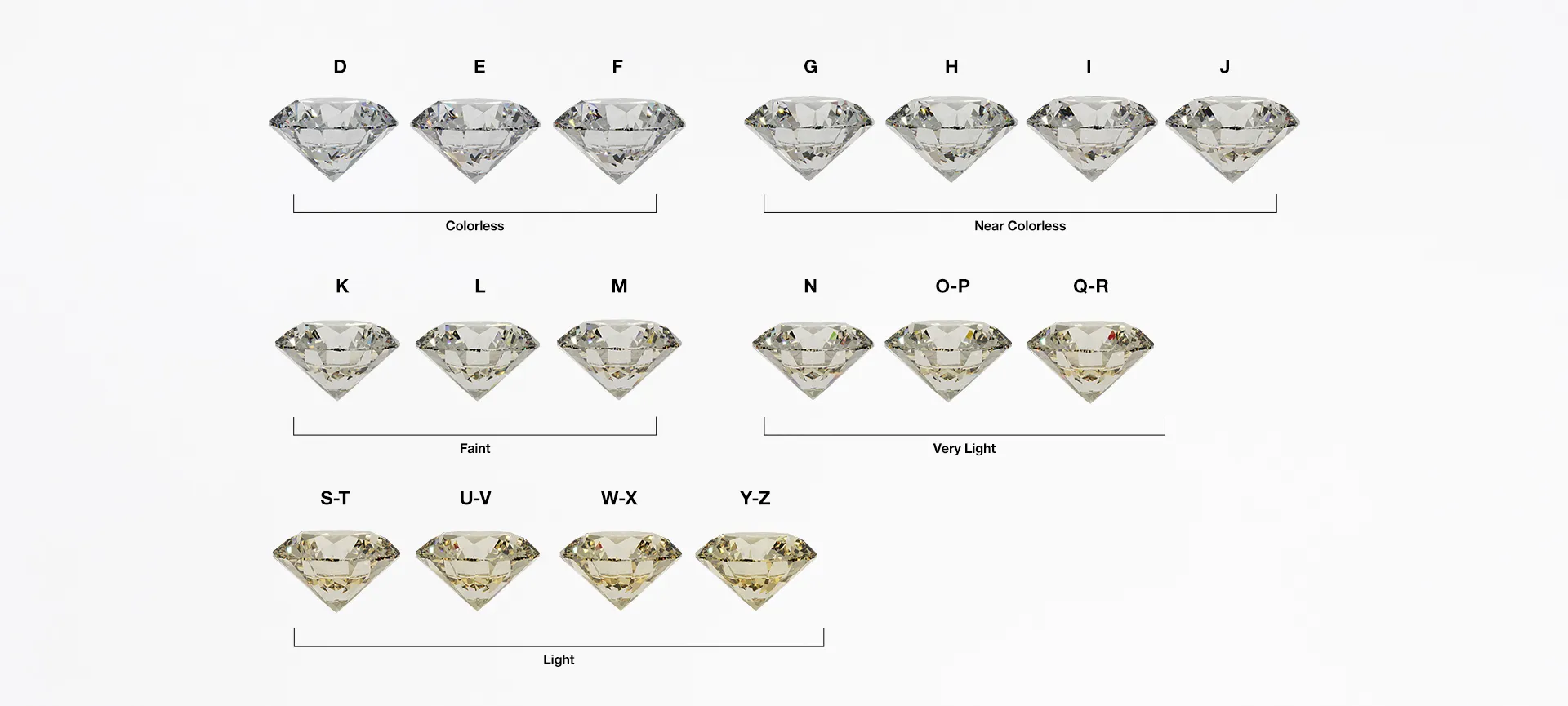
What Does Colourless to Near Colourless Mean on the D-Z Scale?
- D–F (Colourless): Exhibits no discernible colour, representing a premium grade ideal for platinum or white-gold settings.
- G–J (Near Colourless): Displays only minor warmth, typically detectable only by experts, making these an excellent choice for value-conscious buyers.
- K–M (Faint): Shows noticeable colour in white settings, often best suited for yellow or rose gold.
Near-colourless grades generally provide a white appearance at a more accessible price point, making them a popular and practical choice.
How Do Fancy Colour Diamonds Differ in Grading and Value?
Fancy colour diamonds including pink, blue, yellow, and other hues are graded based on the intensity and saturation of their colour, rather than the D–Z scale. Rarer hues and higher levels of saturation command significant premiums. For coloured diamonds, it’s essential to evaluate both the colour grade and clarity to achieve a balance of vibrancy and brilliance.
How Does the Setting Metal Influence the Perceived Colour of a Diamond?
The choice of metal plays a crucial role in how a diamond’s colour is perceived:
- White gold or platinum tends to enhance cool, colourless tones.
- Yellow or rose gold can effectively mask slight warmth in diamonds with lower colour grades.
Selecting a setting metal that harmonises with a diamond’s hue can enhance its apparent whiteness or embrace its warmer character.
What Are Diamond Clarity Grades, and How Can You Identify Eye-Clean Diamonds?
Clarity grading identifies internal and external imperfections, guiding buyers towards stones that appear flawless to the naked eye without incurring unnecessary costs.
What Are the GIA Clarity Grades from Flawless (FL) to Included (I3)?
Diamonds considered eye-clean typically range from FL to SI1, offering both peace of mind and excellent price efficiency.
What Types of Inclusions and Blemishes Affect Clarity?
Common internal inclusions include pinpoints, feathers, and clouds, while external blemishes can range from polish lines to surface graining. Inclusions located near the table facet or clustered together have a more significant impact on value than those situated near the girdle or obscured by facets.
How Can Visual Examples Help You Recognise Eye-Clean Diamonds?
Comparing high-resolution images of VS2 versus SI1 grades under consistent lighting conditions helps train your eye to identify imperfections. Seeking expert guidance and certified visual aids ensures you select a stone whose clarity grade provides both beauty and confidence.
How is Diamond Carat Weight Measured, and How Does It Affect Size and Price?
Carat weight measures a diamond’s mass, but its perceived size is influenced by cut proportions and shape. Understanding unit conversions and pricing structures is key to finding the optimal weight for your budget.
What is the Difference Between Carat Weight and Perceived Diamond Size?
While carat measures weight, the diamond’s diameter and depth determine its face-up size. A well-cut diamond can appear larger per carat than one with deeper or shallower proportions, making proportional analysis essential to avoid compromising brilliance.
How Are Carats Converted to Points, and What Does That Mean?
One carat is divided into 100 points, meaning a 0.75 ct diamond is equivalent to 75 points. Point measurements allow for precise weight matching below full-carat increments, enabling buyers to achieve a finer balance between size and cost.
Why Does Price Increase Exponentially with Carat Weight?
As carat weight increases, the availability of gem-quality diamonds diminishes, making larger stones exponentially rarer. This scarcity drives prices upward on a per-carat basis. Consequently, even slight adjustments in weight can lead to substantial savings without a noticeable decrease in apparent size.
Which Diamond Certification Bodies Should You Trust: GIA vs IGI and Others?
Independent certification guarantees consistency, objectivity, and buyer confidence. Leading laboratories establish the benchmarks for grading, reporting, and verification.
What Makes GIA the Gold Standard for Natural Diamond Grading?
The Gemological Institute of America pioneered the 4 Cs and maintains rigorous, unbiased grading protocols that are recognised globally. Their reports include detailed facet diagrams and precise measurements, upholding consistent standards for natural diamonds.
How Does IGI Certify Lab-Grown Diamonds Differently?
The International Gemological Institute specialises in grading lab-grown gemstones, applying the same 4 Cs methodology while clearly distinguishing their origin. Their comprehensive reports support buyers seeking ethical and more budget-friendly options.
Why Is Certification Crucial for Authenticity and Value?
A trusted grading report verifies a diamond’s attributes, origin, and treatment history, protecting against misrepresentation and ensuring fair market pricing. Certification adds essential transparency and contributes to long-term value retention.
How Are Lab-Grown Diamonds Graded, and What Should Buyers Know?
Lab-grown diamonds share the same carbon composition as natural stones but follow evolving grading conventions to reflect their origin and market positioning.
What Are the Differences Between GIA’s New Lab-Grown Grading and IGI’s 4 Cs Approach?
GIA now labels lab-grown diamonds as “Standard” or “Premium” alongside 4 Cs details for clarity, without implying natural origin. IGI continues to apply classic 4 Cs grading with clear disclosure of origin. Understanding these distinctions helps you compare reports effectively.
What Ethical and Environmental Considerations Influence Lab-Grown Diamond Choices?
Cultivated gemstones offer reduced land disruption, lower carbon footprints, and transparent supply chains. Buyers prioritising sustainability often choose lab-grown diamonds to support ethical practices without compromising on quality.
How Does Lab-Grown Diamond Certification Impact Price and Quality?
Lab-grown diamonds typically cost 20–40 percent less per carat than natural equivalents with similar 4 Cs grades. Certification ensures reliable quality benchmarks and affirms value propositions for both budget-conscious and ethically driven customers.
How Can You Make an Informed Diamond Choice Balancing Quality, Value, and Personal Preference?
Selecting the ideal diamond involves making strategic trade-offs across the 4 Cs, shapes, settings, and customisation options, guided by your personal priorities.
How Do Trade-Offs Between the 4 Cs Affect Appearance and Cost?
- Enhanced Cut, Lower Carat: Maximises sparkle while achieving modest weight savings.
- Near-Colourless, Higher Clarity: Maintains a white appearance while securing eye-clean purity.
- Larger Carat, Moderate Clarity: Increases presence with minimal visible inclusions.
What Diamond Shapes and Settings Complement Different Grading Qualities?
- Round brilliant shapes beautifully highlight fire in Excellent cuts.
- Oval or marquise shapes appear larger per carat but require precise symmetry to avoid bow-tie effects.
- Yellow-gold halos can enhance warmth in diamonds with lower colour grades.
- Platinum prong settings effectively emphasise colourless grades.
How Can Customisation Enhance Your Engagement Ring Selection?
Bespoke designs from unique metal alloys to custom-designed settings for lab-grown centre stones, allow you to integrate your personal style, ethical values, and budget considerations. Custom craftsmanship at ADC.com.au ensures that every diamond is showcased to its absolute best potential.
What Are the Most Common Questions About Diamond Grading Scales?
What Are the 4 Cs of Diamond Quality?
The 4 Cs, Cut, Colour, Clarity, and Carat Weight are standardised criteria used to evaluate a diamond’s light performance, colourlessness, internal purity, and mass, as established by leading gemological institutes.
Which Diamond Grade Offers the Best Value?
Diamonds in the near-colourless range (G–J) with Very Slightly Included (VS1–VS2) clarity and an Excellent to Very Good cut grade typically offer exceptional brilliance and purity at moderate price points.
How Does Diamond Cut Affect Sparkle?
A diamond’s cut dictates how its facets interact with light. An Excellent cut returns nearly all light through the crown, maximising brilliance, fire, and scintillation, whereas a poor cut allows light to escape, significantly reducing sparkle.
Is GIA or IGI Certification Better for Diamonds?
For natural diamonds, GIA is widely recognised as the premier standard due to its rigorous, unbiased grading protocols. For lab-grown diamonds, IGI provides comprehensive 4 Cs grading with clear origin disclosure, making both bodies highly trustworthy within their respective specialisations.
By mastering diamond grading scales and understanding certification insights, you’ll gain the expertise needed to select a stone that truly reflects your values, personal style, and investment goals. Whether you choose a natural GIA-certified gem or an ethically sourced lab-grown diamond, making informed decisions paves the way to an enduring symbol of your commitment.


