
Finding the perfect ring is more than just falling in love with a design, it’s about getting that perfect, comfortable fit. It all starts with knowing your ring size, and the good news is you can get a surprisingly accurate measurement right from the comfort of your own home.
Your Guide to a Perfect Ring Fit
A ring that fits just right is crucial, not just for comfort but for the security of a piece you’ll treasure forever, like an engagement ring. As experts in fine jewellery, we will walk you through two reliable methods you can use today, ensuring your final choice feels like it was made just for you.
You can determine your measurement in a couple of ways:
- Measuring a ring you already own that fits perfectly.
- Measuring your finger directly using a simple tool.
Think of us at Australian Diamond Company as your personal guide in this important first step. We’re here to make sure you feel completely confident in your size before you explore our exclusive collections, beautifully crafted in your choice of 9kt gold, 18kt gold, or platinum.
Using String or Paper to Measure Your Finger
This classic method is a surprisingly reliable way to find your ring size if you don’t have another ring handy that fits perfectly. It just requires a couple of simple household items and a bit of careful attention to get an accurate result.
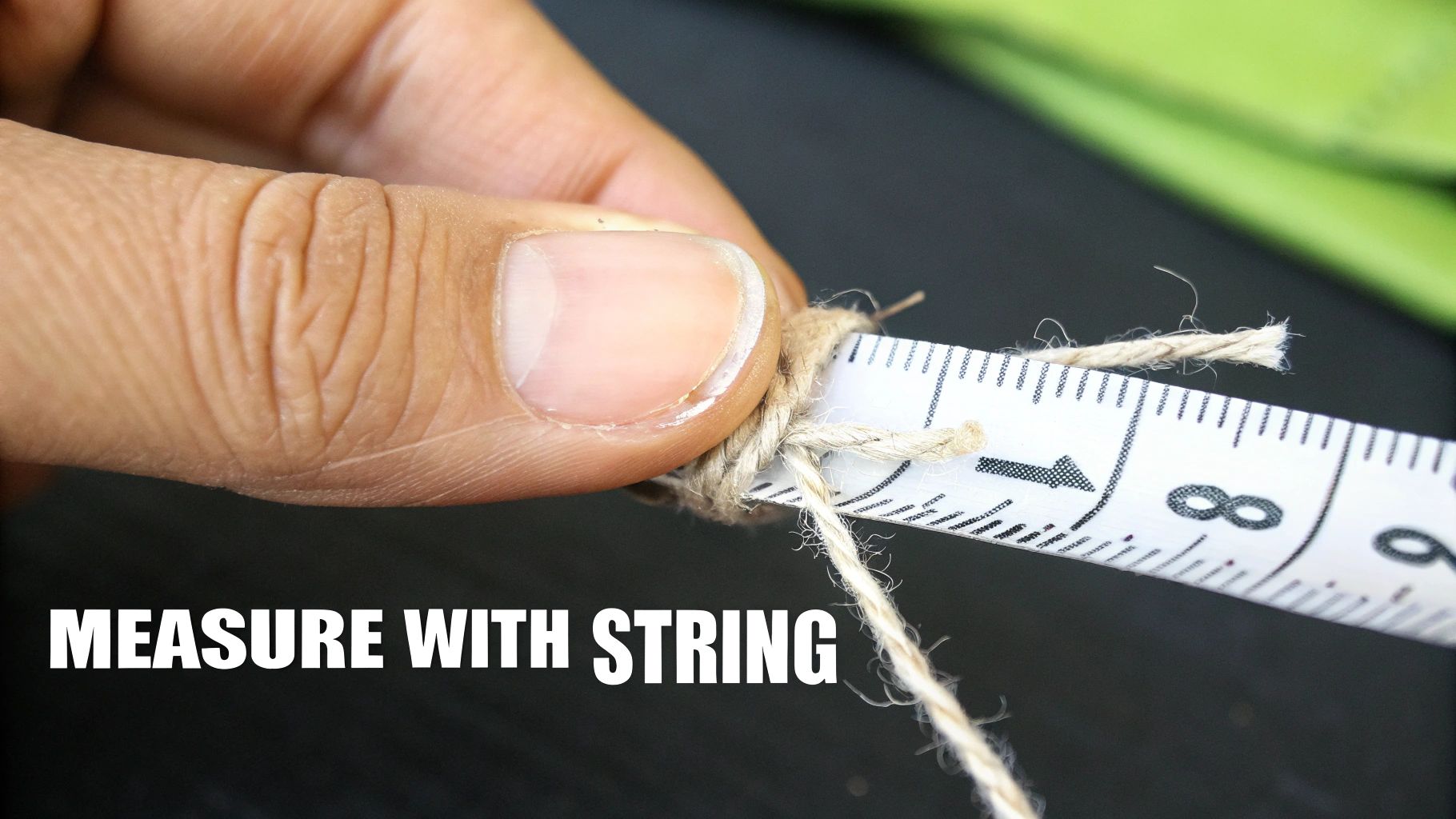
First, find a piece of non-stretchy string, dental floss, or even just a thin strip of paper. You’ll want to wrap it around the base of the finger you’re measuring. Make sure it’s snug enough that it won’t just fall off, but also loose enough to comfortably slide over your knuckle. This is a common oversight.
Using a pen, mark the precise point where the end of the string or paper overlaps.
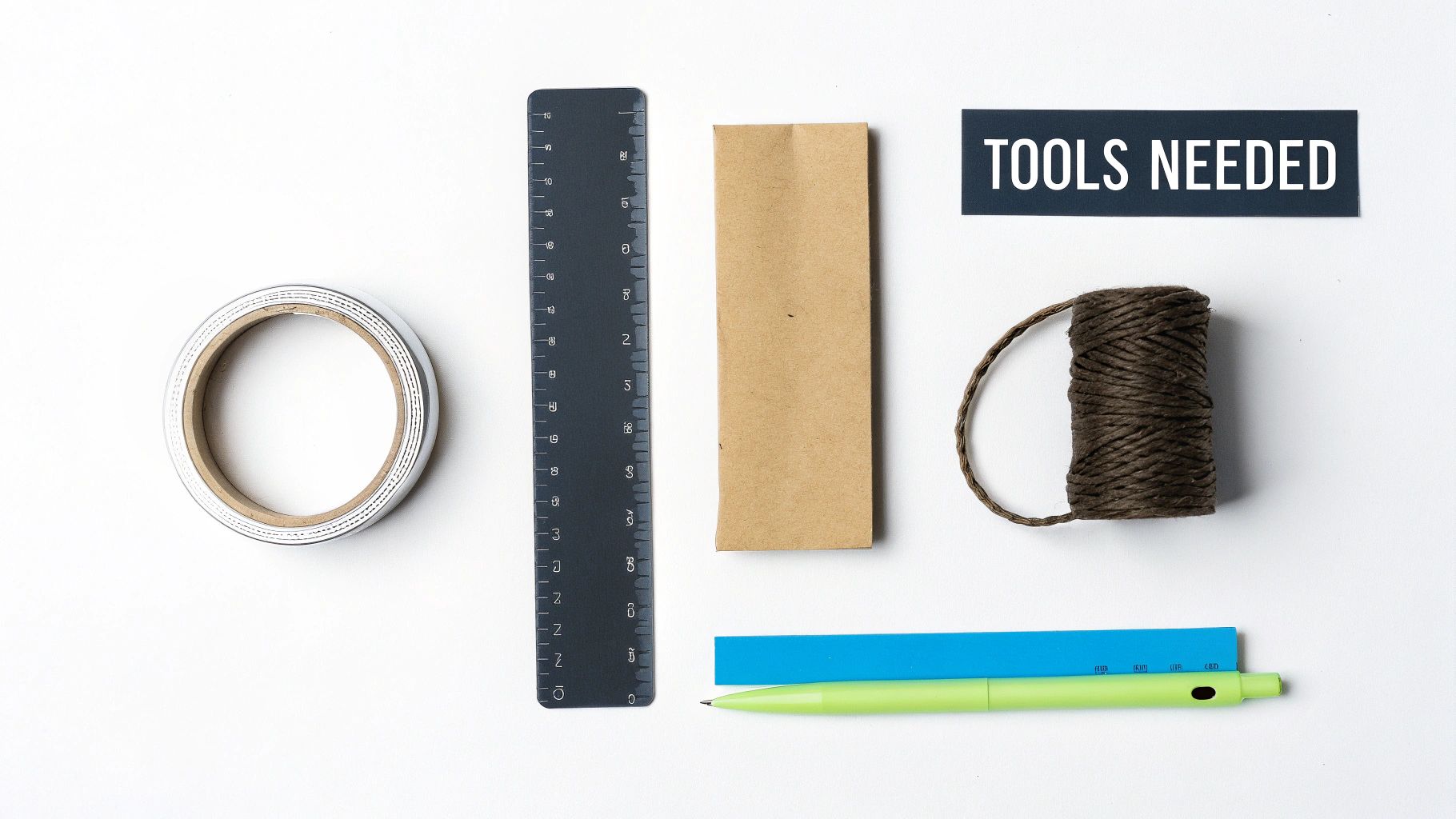
Now, lay your string or paper strip flat against a ruler and measure the length from the end to your mark in millimetres. This measurement is your finger’s circumference, which you can then match to the alphabetical ring size scale we use here in Australia. You can find a complete conversion chart in our comprehensive guide to measure your ring size.
Expert Tip: We always advise measuring your finger towards the end of the day. Our fingers naturally swell a little as the day goes on, and measuring later ensures your new ring will feel comfortable from morning to night.
Finding Your Size with an Existing Ring
If you have a ring that already fits the intended finger perfectly, you’re in luck. This is one of the most straightforward and reliable ways to find your ring size right from the comfort of your own home.
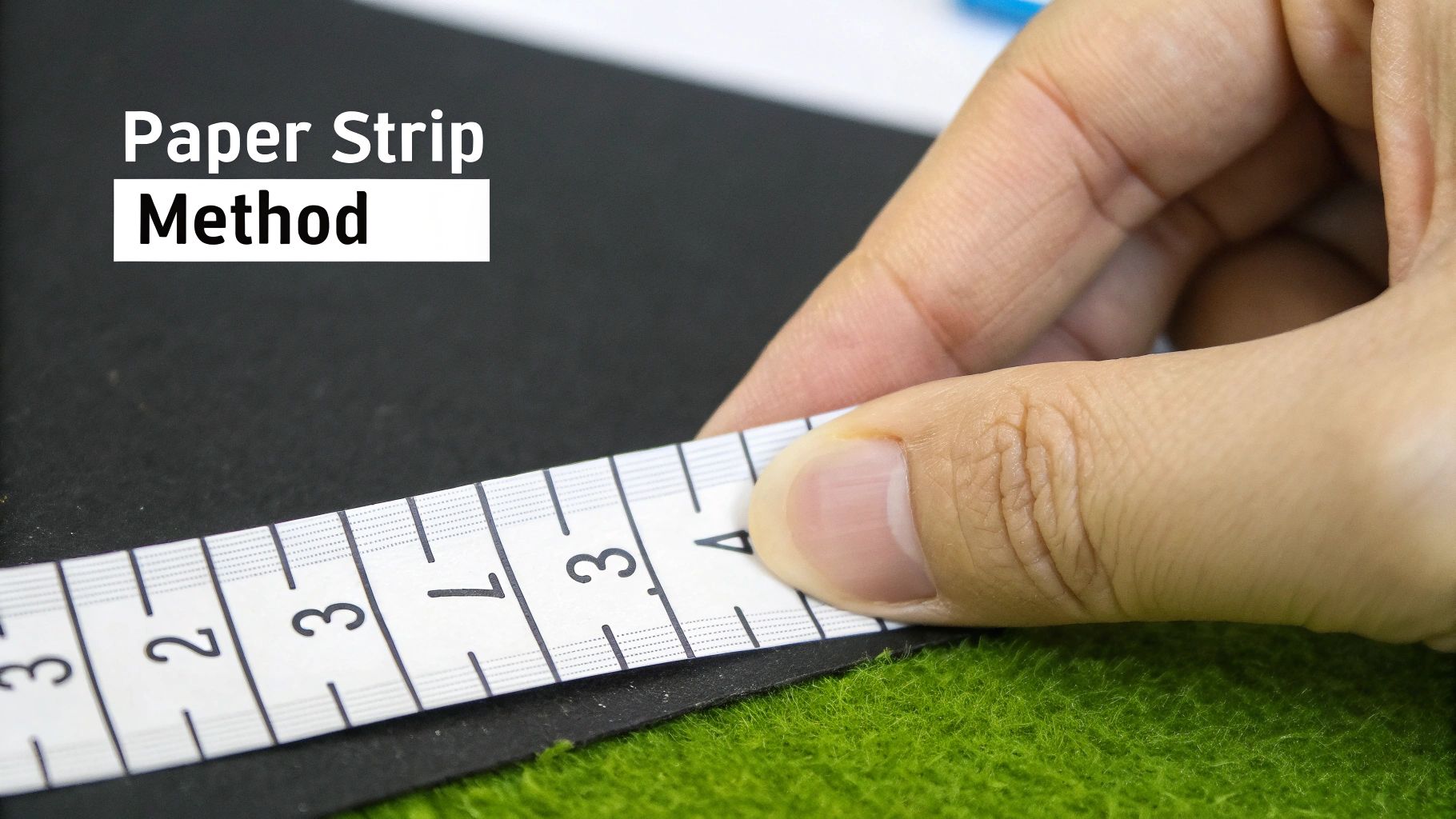
All you need to do is lay the ring flat on a ruler and carefully measure its internal diameter in millimetres. The trick is to measure straight across the very centre of the ring, from one inside edge to the other. This single measurement is all it takes to determine your correct size.
Once you have that number jotted down, you can easily convert it to the corresponding Australian alphabetical size using our official Australian Diamond Company ring size guide.
Here’s a crucial tip we always share with our clients: pay close attention to the width of the band. If the ring you’re measuring has a thin, delicate band but the new one you’re considering is much wider, you will likely need to go up a half-size to ensure it fits comfortably.
A Few Insider Tips for an Accurate Measurement
Achieving that flawless, “made-for-you” fit is about more than just one quick measurement. Our fingers are surprisingly dynamic, subtly changing size throughout the day due to temperature and activity. For true accuracy, it’s best to measure your finger two or three different times, say, in the morning, afternoon, and again in the evening, and take a comfortable average.
Remember, the ring is for a specific finger, so be sure to measure that one. It’s a common oversight, but your dominant hand is often a fraction larger than your non-dominant one. You’ll also need to consider your knuckle. A ring should feel snug and secure at the base of your finger, but it still needs to slide over the knuckle without a major struggle.
The width of the band itself plays a significant part, too. A wider band displaces more skin and will naturally feel tighter. Many people find they need to go up half a size to accommodate a more substantial design.
Did you know our fingers can fluctuate in size? This is a key reason why many ring returns in the industry are linked to incorrect sizing, which truly highlights the need for precision.
Understanding these little nuances is the secret to getting it right the first time. But if you ever find an adjustment is needed down the track, you can learn all about what’s possible in our guide to ring resizing and why it works.
Australian Ring Size Conversion Chart
Once you’ve got your measurement in millimetres, you’re on the home stretch. The chart below is your key to translating that number into a proper Australian ring size. It’s a straightforward way to convert either your finger’s circumference or the internal diameter of an existing ring into the official alphabetical size.
This takes all the guesswork out of the equation.
Think of this as your visual guide, helping you confidently match your at-home measurement to the correct size. Australian sizing is incredibly precise, having evolved over many years to the accurate metric scale we use today.
Knowing your size gives you complete peace of mind, especially when you’re navigating the exciting process of learning how to choose an engagement ring and getting ready to select a beautiful piece in 9kt gold, 18kt gold, or platinum.
Australian Ring Size Conversion Guide
Use this table to convert your finger circumference or a ring’s internal diameter measurement (in mm) to the corresponding alphabetical Australian ring size.
| Circumference (mm) | Internal Diameter (mm) | Australian Ring Size |
|---|---|---|
| 44.2 | 14.1 | F |
| 45.5 | 14.5 | G |
| 46.8 | 14.9 | H |
| 48.0 | 15.3 | I |
| 49.3 | 15.7 | J |
| 50.6 | 16.1 | K |
| 51.9 | 16.5 | L |
| 53.1 | 16.9 | M |
| 54.4 | 17.3 | N |
| 55.7 | 17.7 | O |
| 57.0 | 18.1 | P |
| 58.2 | 18.5 | Q |
| 59.5 | 19.0 | R |
| 60.8 | 19.4 | S |
| 62.1 | 19.8 | T |
| 63.4 | 20.2 | U |
| 64.6 | 20.6 | V |
| 65.9 | 21.0 | W |
| 67.2 | 21.4 | X |
| 68.5 | 21.8 | Y |
| 69.7 | 22.2 | Z |
| 71.0 | 22.6 | Z+1 |
Simply find your measurement in the first or second column, then look across to find your perfect fit.
Common Questions About Finding Your Ring Size
Even with the most careful at-home measurements, a few questions can arise. This is completely normal. We’ve gathered some of the most common queries we hear from our clients to give you clear, expert answers and help you feel totally confident in your choice.
What if My Measurement Is Between Two Sizes?
This happens quite often. If you find your measurement falls squarely between two standard ring sizes, our advice is always to select the larger of the two.
It’s a straightforward process for our skilled jewellers to precisely adjust a ring that’s slightly too big. Making a ring larger, on the other hand, is a much more complex task. Opting for the larger size gives you the most flexibility.
Does the Ring Band Width Affect the Size?
Absolutely, and this is a crucial detail many people overlook. A wider band, think anything 6mm or more, covers a larger surface area of your finger. This creates more friction and will feel much snugger than a delicate, thin band of the very same size.
For these bolder, more substantial styles, we often recommend going up half a size to ensure a comfortable fit. This is an important factor to keep in mind when you’re drawn to more intricate designs, like our beautiful three-stone engagement rings.
Expert Takeaway: Always measure the specific finger on the hand you plan to wear the ring on. Most people find their dominant hand is about half a size larger than their non-dominant one.
At Australian Diamond Company, our expertise is always at your service. If you’d like to be absolutely sure, book a consultation with our specialists. We can confirm your size professionally and help you explore our exquisite collections in person.


